
Family: Columbidae
The most common and easiest pigeon to find throughout the world, the rock dove (or feral pigeon) has the characteristic pigeon shape: small head, plump body, thicker legs.
Rock doves are usually about 33 cm in length, a bit smaller than the common woodpigeon. Typical specimens have a light gray plumage which is more or less uniform, with two black stripes on the wings and dark wingtips. They have metallic-looking feathers across the neck, shining bright green and purple and sometimes spreading down to the chest.
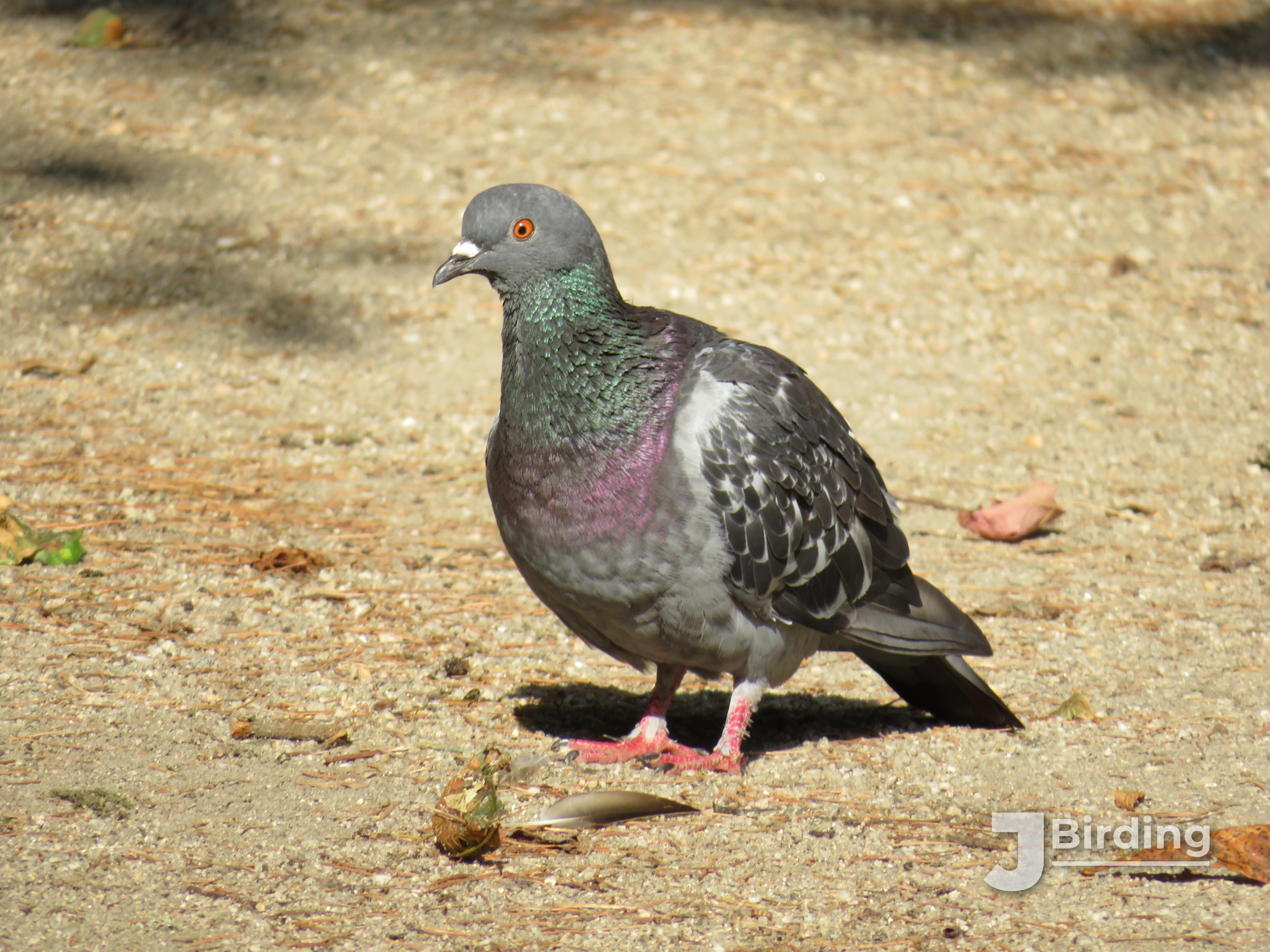 Columba livia
Stock doves (Columba oenas) Columba oenas
Frank Vassen from Brussels, Belgium, CC BY 2.0, via Wikimedia Commons
can be easily mistaken for this species. However, they are a bit smaller, have completely dark eyes (as opposed to orange), and their shiny neck feathers are only present on the nape.
There are very few fully wild rock doves nowadays. Instead, most are hybrids with feral or escaped domestic pigeons. This is unusual across birds and has several consequences.
 A partially leucistic pigeon.
Regarding their physical appearance, domestic pigeons have been subjected to artificial selection, exaggerating certain natural mutations. For this reason, feral pigeons display many variations in their plumages, considerably more than other species. Brown, white or completely dark pigeons, in contrast with the typical gray. Furthermore, leucismLoss of color of the feathers, which become white. It can be partial or total. Not to be confused with albinism. is very common in this species, more so than others. Other genetic variations, such as feathered legs, are also relatively common, albeit not as much as differences in the plumage.
On another hand, this species’ domestic past also plays a role in its modern habitat, Feral pigeons are widespread throughout most of the world, with few exceptions, and live chiefly in towns and cities. One of the reasons is the similarity between their natural habitat (rocky cliffs) and human buildings. Nonetheless, their domestication is the main factor. Specimens that escape or are freed from captivity are the main drive of this species’ expansion, and their affinity for humans (partly derived from their domestication) facilitates their establishing populations in urban environments.
Feral pigeons don’t make many sounds—they’re silent most of the time. The main sound they emit is a soft coo, particularly common during mating.
-
↑
 Columba oenas
Frank Vassen from Brussels, Belgium, CC BY 2.0, via Wikimedia Commons - ↑ Loss of color of the feathers, which become white. It can be partial or total. Not to be confused with albinism.